
Engineering for Extreme Maritime Challenges
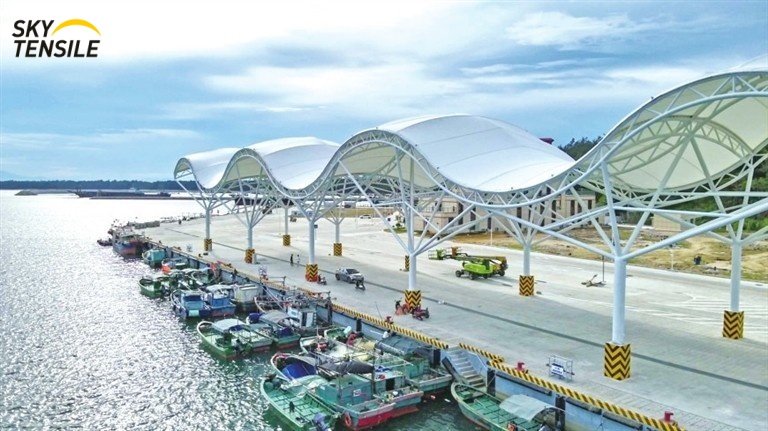
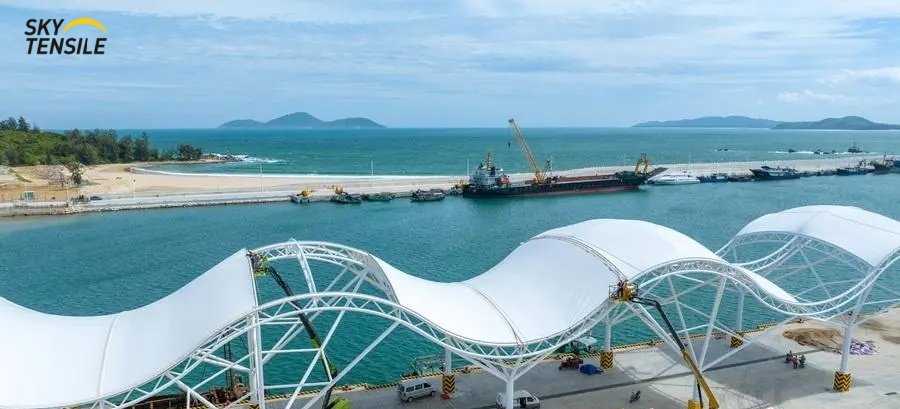
The PTFE tensile membrane structure at Wang Ning Fishing Port, China, represents a significant advancement in coastal infrastructure. As a critical hub supporting over 40,000 fishing vessels, the terminal requires a protective envelope that can withstand some of the most aggressive environmental conditions on the planet. By implementing a high-performance PTFE tensile membrane structure, SkyTensile has provided a 3,500-square-meter solution that balances architectural elegance with industrial-grade resilience.
Typhoon-Resistant Design for Open-Sea Exposure
Wang Ning is located in a high-risk typhoon zone, where wind loads can exceed typical building tolerances. To address this, our PTFE tensile membrane structure was engineered with a focus on aerodynamic stability and high tension.
- 8000N Tensile Strength: We utilized premium PTFE-coated fiberglass with a tensile strength of 8000N/5cm. This ensures the structure maintains its shape and integrity even under extreme uplift forces during seasonal storms.
- Precision Steel Framework: The supporting steel system is optimized through form-finding software to redistribute stress evenly, preventing localized fabric failure during 17-grade typhoon gusts.
Solving the “Salt-Spray” Corrosion Problem
Coastal projects face a silent enemy: salt-laden humidity. Traditional metal roofing often succumbs to rust within 5-10 years. However, our PTFE tensile membrane structure offers a vastly superior alternative.
- Chemical Inertness: PTFE is chemically inert, meaning it will not react with salt, acid rain, or UV radiation. This allows the terminal roof to remain functional and aesthetically pleasing for over 30-50 years.
- Marine-Grade Protection: To complement the membrane, the steel components underwent rigorous galvanization and epoxy coating, specifically designed for the 1.5 million square kilometers of maritime area it serves.
Operational Efficiency & Energy Savings
Beyond durability, the PTFE tensile membrane structure significantly enhances the operational environment of the port.
- Natural Daylighting: With high light transmission, the PTFE fabric allows soft, diffused sunlight to penetrate the docking and logistics areas. This reduces the need for artificial lighting during the day, lowering energy costs.
- Self-Cleaning Advantage: The low surface energy of the PTFE coating means that salt deposits and dust are easily washed away by natural rainfall. For a large-scale port facility, this self-cleaning feature reduces maintenance overhead and ensures the structure retains its bright, professional appearance.
Global Scalability of Chinese Engineering
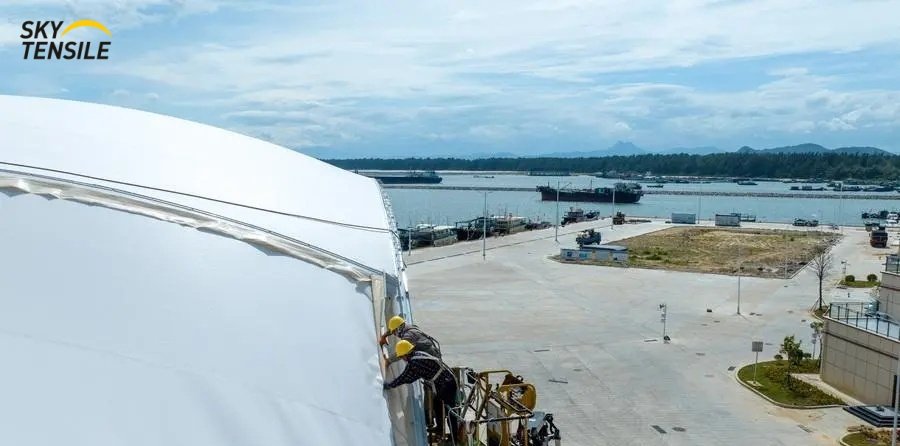
This project in Wang Ning serves as a scalable model for modular, sustainable marine engineering globally. It proves that a PTFE tensile membrane structure is the most viable solution for regions facing similar challenges, such as the Caribbean, Southeast Asia, or the Middle East. By leveraging advanced manufacturing in China, SkyTensile provides cost-effective, high-stakes architecture that meets international safety standards including ASTM E84 and DIN 4102 B1.
Your Partner in Coastal Resilience
At SkyTensile, we specialize in transforming complex design inspirations into durable realities. The Wang Ning project stands as a testament to the versatility and strength of modern tensile architecture. If you are planning a port terminal, transport hub, or coastal landmark, contact our experts to discuss your PTFE tensile membrane structure needs.
Project Data Summary:
- Location: Wang Ning, Hainan, China (Coastal/Marine Climate)
- Key Challenge: Grade 15+ Typhoon resistance & Salt-spray corrosion.
- Solution: SkyTensile 8000N Marine-Grade PTFE Membrane.